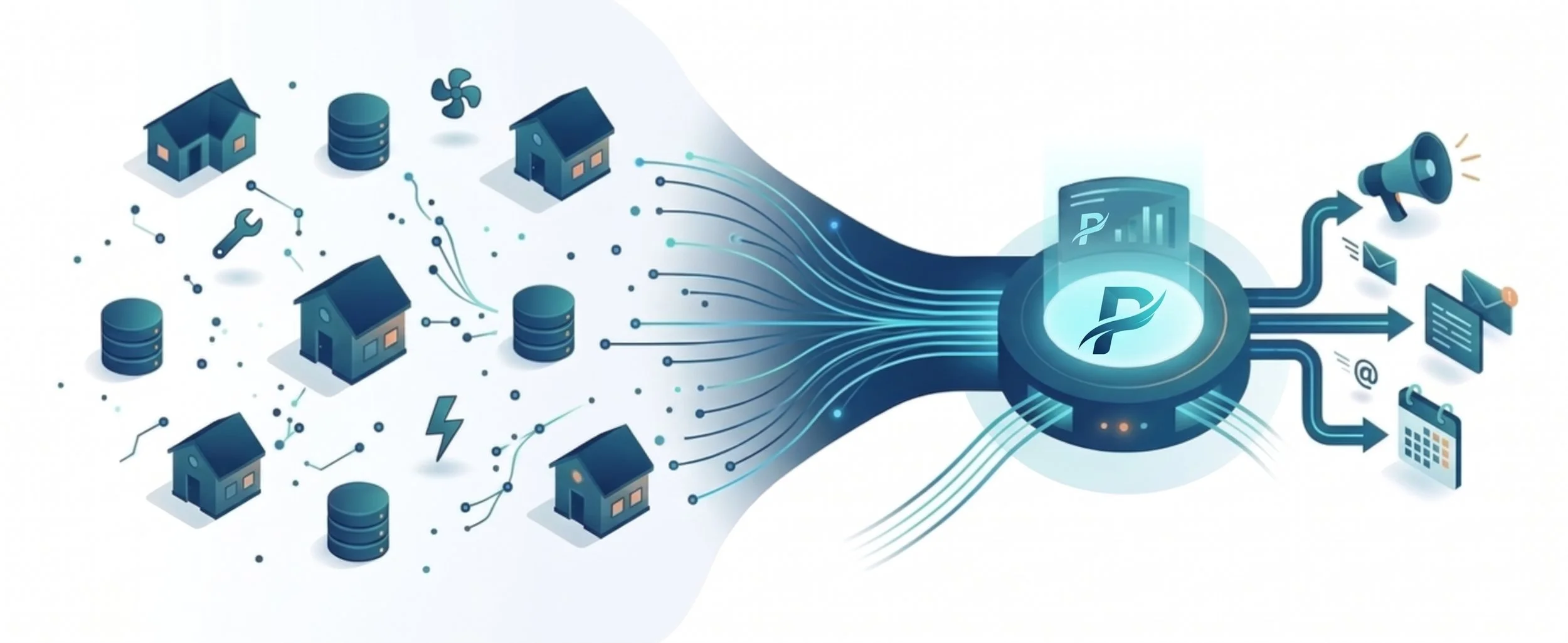
Home services are consolidating fast. Private equity firms are buying home services brands at a pace the industry hasn't seen before. The pitch is simple: combine dozens of strong local operators, add shared resources and capital, and build a national leader.
What usually breaks that model isn't operations or talent. It's data.
Each acquired brand comes with its own customer database and its own marketing habits. On paper, the firm owns millions of customer relationships. In practice, those relationships are spread across various systems that need to talk to each other. Marketing growth stalls because there is no single engine that powers outreach in an intelligent way.
We've worked with one of the country's largest PE-backed home services portfolios (with 150+ local brands) to solve exactly that problem. The following was our approach.
Step 1: Unify the data
When we started, our first job was integration. We ingested millions of job records and customer profiles into an AI-powered customer data platform (CDP) – primed for marketing orchestration. This allowed us to contact our client’s customers using a single, unified, omnichannel platform.
Step 2: Replace blasts with journeys
Most home services marketing still focuses on high-volume promotional blasts (eg: a seasonal tune-up offer sent to everyone) with targeting that isn’t overly sophisticated.
With unified data in place, we replaced that model with trigger-based, omnichannel campaigns built on real customer journey data. That means reaching homeowners based on their actual history, location, and needs: the age of their equipment, jobs completed, the time since their last service, seasonal and weather related messaging, etc.
The result is conversion rates up to 5X higher than the pre-existing marketing platforms.
Step 3: Measure what actually drives returns
In a multi-brand platform, marketing decisions are only as good as the reporting behind them. Our reporting answers the questions that really matter: did this campaign drive revenue, or would that revenue have come in anyway?
We created customer audiences with continuous holdout testing and incrementality measurement. This provides visibility into which marketing investments drive returns and which don't, which helps inform essential decisions for a portfolio of brands.
What's next: Anticipating demand instead of reacting to it
The traditional home services model is reactive. A system breaks and the homeowner calls. What is needed is an anticipation of needs using a combination of customer data and an AI-powered dynamic marketing platform.
We actively expand our marketing models to bring in more operational data and third-party external signals. The goal is to predict when a homeowner's systems are most likely to need service and reach them before they need to pick up the phone.
We think this proactive model is the next frontier of home services marketing. The operators who get there first will have an advantage that's very hard to copy, because it's built on years of unified customer data rather than just ad spend.
The takeaway for PE firms
If you're building or investing in a roll-up, the lesson is to treat data unification as core infrastructure and combine that with an omnichannel marketing platform to grow your brands. Interested in doing this for your portfolio of brands? Petram can help every step of the way.